
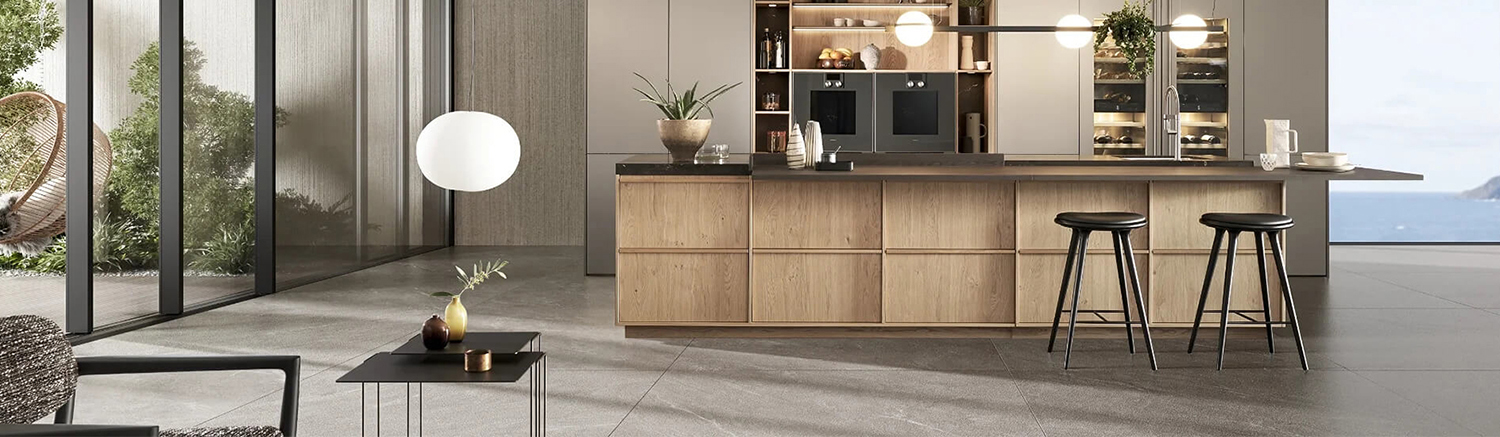
Built-in ovens and steamers have become standard in both residential and contract kitchens, and so has the callback that follows them: thermofoil doors whose edges lift within a year, and white painted doors that develop a yellow patch nearest the appliance. These are not finish defects. They are predictable thermal failures, and they can be specified out of a project before a single cabinet is built.
This article sets out the three failure mechanisms, the three specifications that address them, and the acceptance tests to put in a handover checklist.
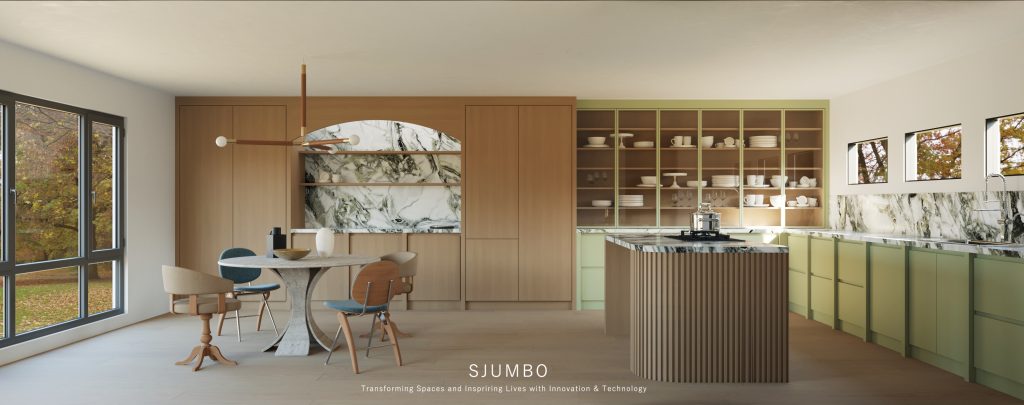
Damage near a built-in appliance is rarely caused by one mechanism. Radiation, conduction and convection act together, and the failure threshold is lower than most specifiers assume.
| Failure mode | Trigger | What you see on site | Root cause |
|---|---|---|---|
| EVA edge banding reverses | Sustained edge temperature above ~60 °C | Edge tape lifts, curls or pops off; visible glue line | EVA is thermoplastic. It re-melts and loses bond strength, and the drop accelerates with temperature. |
| PVC film shrinks and shears | Local temperature above ~65 °C | Hairline cracks at door edges, film separating from substrate | Thermofoil film contracts 0.5–1.0 %, generating shear the adhesive cannot absorb. On a 2400 mm door that is 12–24 mm of movement. |
| PU topcoat yellows | Prolonged radiant heat above ~70 °C | Localised yellow patch closest to the appliance | Oxidative scission of the polymer chain forms chromophores. It starts before it is visible. |
The practical consequence: by the time a homeowner notices a colour shift, the chemical change has been running for months. Specifying a measurable threshold at handover is far cheaper than arguing about it later.
How these numbers were measured. Temperature thresholds, peel strength and colour-difference figures quoted here come from in-house laboratory testing on production-intent samples: 180° peel testing at 23 °C / 50 % RH, accelerated heat ageing in a forced-air oven, and colour measurement with a colorimeter under D65 illuminant. These are manufacturer figures rather than independent certification, so treat them as comparative guidance and confirm against project-specific requirements.
PUR (polyurethane reactive) hot melt cures by cross-linking with ambient moisture. Once cured the bond is irreversible: it will not re-melt the way EVA does. Heat distortion temperature moves into the 120–140 °C range, which puts it comfortably above anything a domestic oven side wall will produce.
Two secondary benefits matter on site. The glue line is 0.1–0.2 mm rather than 0.5–1.0 mm, which reads as a near-zero joint on modern slab doors. And because the cured adhesive is not water-sensitive, the edge stops being the entry point for steam and moisture — which is the real failure driver around steamers and dishwashers.
Peel strength measured above 45 N/cm in our testing, against under 20 N/cm for EVA, and unlike EVA it does not degrade in humid conditions. For the full adhesive comparison, see PUR vs EVA edge banding: which one survives a high-heat kitchen.
A polished stainless steel shield fitted inside the appliance carcass reflects the majority of radiant heat back toward the appliance instead of letting it soak into the adjacent panel. The mirror finish matters: it is the reflectivity, not the thickness, that does the work.
Use food-grade 304, hold thickness to ±0.05 mm, and install it with a step-slot embedding process so it sits flush rather than standing proud. Done properly this keeps the back face of the adjacent door below the 45 °C threshold where finishes remain stable.
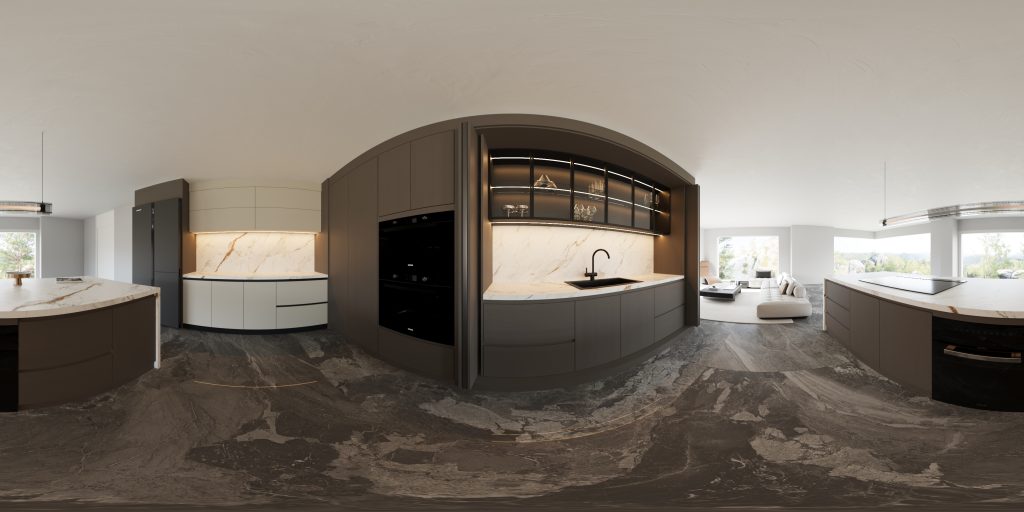
Standard PU lacquers yellow because the polymer chain oxidises under heat. An acrylic/PU composite formulated with UV inhibitors and thermal stabilisers resists that scission. On white doors this is the difference between a uniform run of cabinetry and one visible patch beside the oven.
In accelerated ageing, an anti-yellowing formulation held colour shift below ΔE 1.0 after 500 hours at 120 °C, against visible yellowing (ΔE above 2.0) within 12 months for a standard PU. More on coating selection: how to stop white lacquer doors from yellowing.
| Property | Traditional spec | Heat-protected spec | Gain |
|---|---|---|---|
| Heat resistance threshold | 55–65 °C | 120–140 °C | ≈2× |
| Edge peel strength | <20 N/cm, drops when humid | >45 N/cm, unaffected by humidity | ≈2.5× |
| Colour stability | Visible yellowing in 12 months (ΔE >2.0) | ΔE <1.0 held over 5+ years | ≈5× |
| Moisture resistance at edge | Visible seam, swells with steam | Zero-joint seal, steam resistant | ≈3× |
| Radiant heat blocked | None — direct transfer | >90 % reflected by mirror shield | — |
How much clearance does a built-in oven need from an adjacent cabinet?
Keep a minimum 5 mm air gap between the oven side wall and the cabinet panel, 8 mm behind the oven, and 10 mm of ventilation space above. Steamers may drop to 3 mm because they run cooler. Always defer to the appliance manufacturer’s installation manual when it is stricter.
Can a heat shield repair a cabinet door that has already delaminated?
No. A heat shield only prevents further damage. Once the PVC film has separated from the substrate the deformation is irreversible, and re-gluing will not restore flatness. Replace the door with a PUR-banded unit and fit the shield at the same time.
How do I verify a supplier actually used PUR edge banding?
Check three things: the glue line (PUR is 0.1–0.2 mm and translucent; EVA is 0.5–1.0 mm and opaque white), the flexibility (PUR bends further without fracturing), and the paperwork (batch-level application records and peel strength reports). On a bulk order, make the reports a delivery condition.
What colour difference threshold should a spec require for white painted doors?
Require an initial ΔE below 0.5 at handover, measured with a colorimeter under D65 lighting, and set the maximum acceptable drift at ΔE 1.0 after five years of service. Putting a number in the contract turns a subjective complaint into a measurable defect.
Do steamers need the same heat protection as ovens?
Steamers run cooler but release far more moisture, so the failure mode shifts from thermal shrinkage to edge swelling. Clearance can drop to 3 mm, but PUR edge banding and a sealed shield are still worth specifying — the moisture load alone will defeat an EVA edge.
Will a stainless steel heat shield interfere with hinges and drawer slides?
Not if it is step-slot embedded. Define the shield position in the shop drawings, offset hinge boring at least 15 mm from the shield, and fit insulating gaskets between drawer slides and the side panel to avoid thermal bridging.
On multi-unit residential and hospitality projects, the cost of a heat-protected spec is a small increment on the door price. The cost of not specifying it is a callback programme across every kitchen in the building — and appliance zones are where those callbacks concentrate.
The specifications above are only useful if they survive the handoff from design to factory. Put them on the production order as line items, not in an email.
Less than six months after handoff on a luxury villa pr […]
If you have bathroom cabinet design sketches and want t […]
Mold-resistant bathroom cabinet is an essential bathroo […]
Most families who have renovated their bathrooms have e […]
Related links:
About Us Company News Industry Updates Kitchen Cabinets Bathroom Suites Wardrobes Wall Systems Doors Windows & Balustrades SSL 100% Secure Transactions