
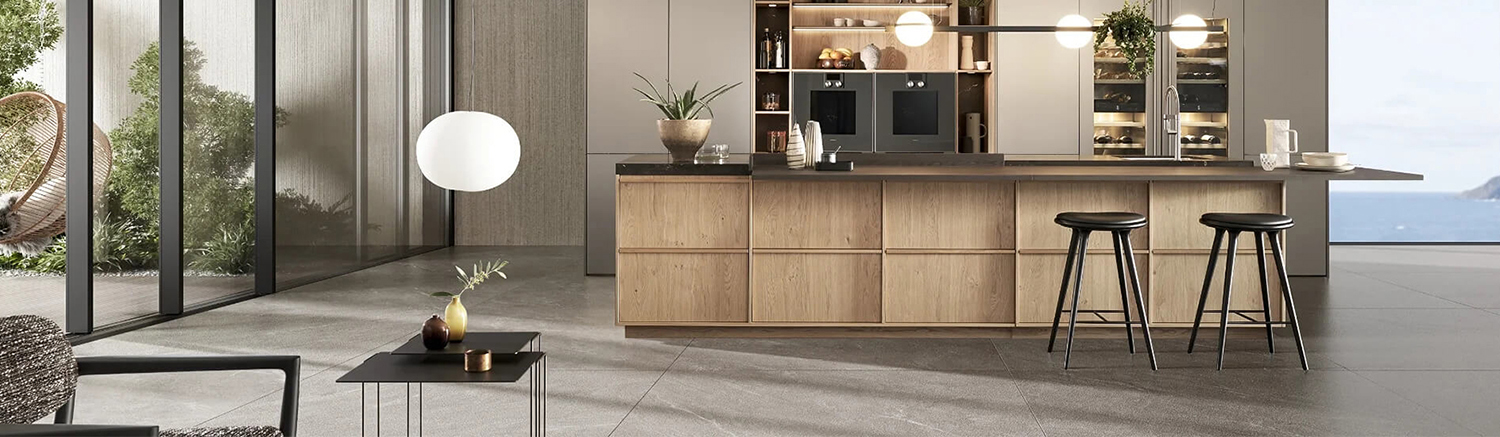
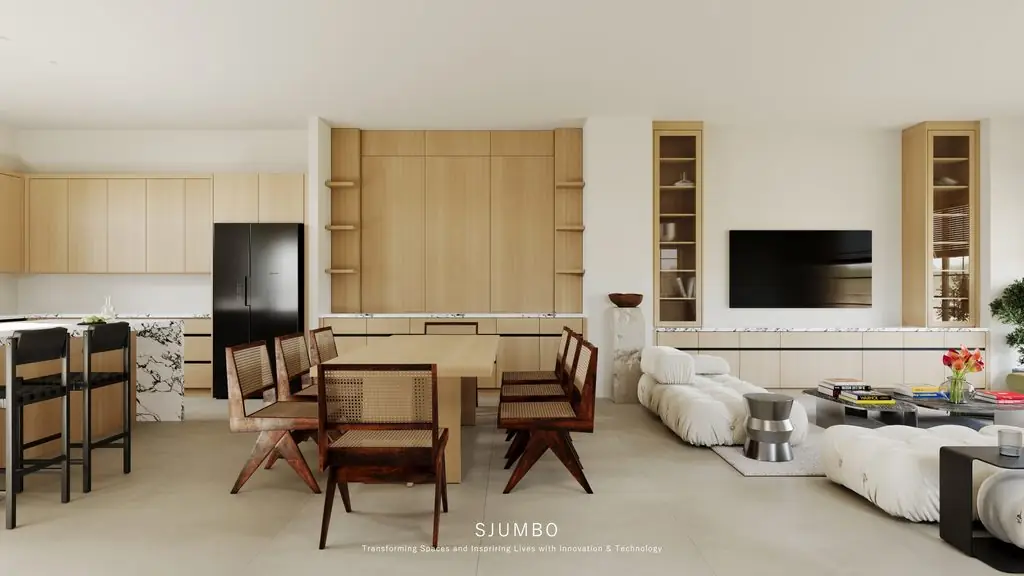
When it comes to full-house custom cabinet material matching, the kitchen and bathroom are the highest-risk spaces for costly mistakes. Many projects focus only on per-space functionality, ignoring the logic of full-house color integration, and end up with a disjointed, cheap-looking finish. For contractors, designers and procurement teams, kitchen and bathroom cabinet selection needs to balance practical performance, proper cabinet moisture-proof material selection, and a cohesive premium look — all while avoiding quality gaps after delivery. With 16 years of export project experience, SJUMBO Full-House Custom Furniture has compiled this complete guide, from failure diagnosis to advanced matching strategies, to help you solve material mismatches and visual disconnects once and for all.
It is all too common to see glossy PET in the kitchen, wood-grain particleboard in the bathroom, and matte lacquer in the living room. When materials, sheens, and textures have zero continuity from one space to the next, the entire home feels furnished in pieces rather than designed as a whole. This is where open kitchen and bathroom color coordination is most often overlooked. In open floor plans, kitchen and bathroom sightlines overlap far more — mismatched materials stand out dramatically, and even well-executed individual spaces feel thrown together.
Bathrooms have constant high humidity and regular water splashes; kitchens have moisture near sinks and dishwashers, plus grease and heat exposure. Using non-moisture-resistant particleboard or standard MDF in these spaces leads to swelling, peeling edges, and warping within 1–2 years. This kind of functional damage doesn’t just look cheap — it drives up warranty and service costs, especially in humid climates. If you’re wondering how to avoid cheap-looking custom furniture, fixing material-to-environment mismatches is the very first step.
Many teams focus only on the grade of the panels themselves, but edge banding and hardware make or break perceived quality. When edge strips have a visible color difference from the panel, or when different rooms use completely different handle styles and finishes, even mid-range materials come across as low-end. Exposed cabinet sides and drawer edges are where workmanship shows most clearly — poor edge banding with visible glue lines and color mismatch instantly drags down the entire perceived quality level.
Below is a side-by-side comparison of 5 mainstream cabinet materials, rated for the specific demands of kitchens (grease, light moisture) and bathrooms (high humidity, direct water contact).
| Material Type | Moisture Resistance / Swelling Rate | Flatness / Scratch Resistance | Emission Grade | Cost Index | Premium Look Index |
|---|---|---|---|---|---|
| Multi-Ply Plywood | Good / moderate swelling; stable when sealed | Excellent / flat surface, strong screw-holding | ENF / F★★★★ | ★★★☆☆ | ★★★★☆ |
| Moisture-Resistant Multi-Ply Board | Excellent / low swelling; waterproof adhesive barrier | Excellent / dimensionally stable, warp-resistant | ENF / F★★★★ | ★★★★☆ | ★★★★☆ |
| Aluminum / Stainless Steel Frame | Excellent / zero water absorption, rust-proof | Good / metallic finish, prone to fine scratches | Formaldehyde-free | ★★★★★ | ★★★☆☆ |
| PET Decorative Panel | Moderate / depends on substrate; surface water-resistant | Excellent / scratch & stain resistant, easy to clean | ENF substrate / Low VOC | ★★★☆☆ | ★★★★★ |
| High-Density Particle Board | Poor / swells easily; requires perfect edge sealing | Good / smooth surface, ideal for laminates | E0 / F★★★ | ★★☆☆☆ | ★★☆☆☆ |
Note: More stars = higher unit cost. Emission grades reference GB/T 39600 (ENF) and JIS A 1460 (F4-Star). Export projects require additional regional certifications such as CARB and CE.
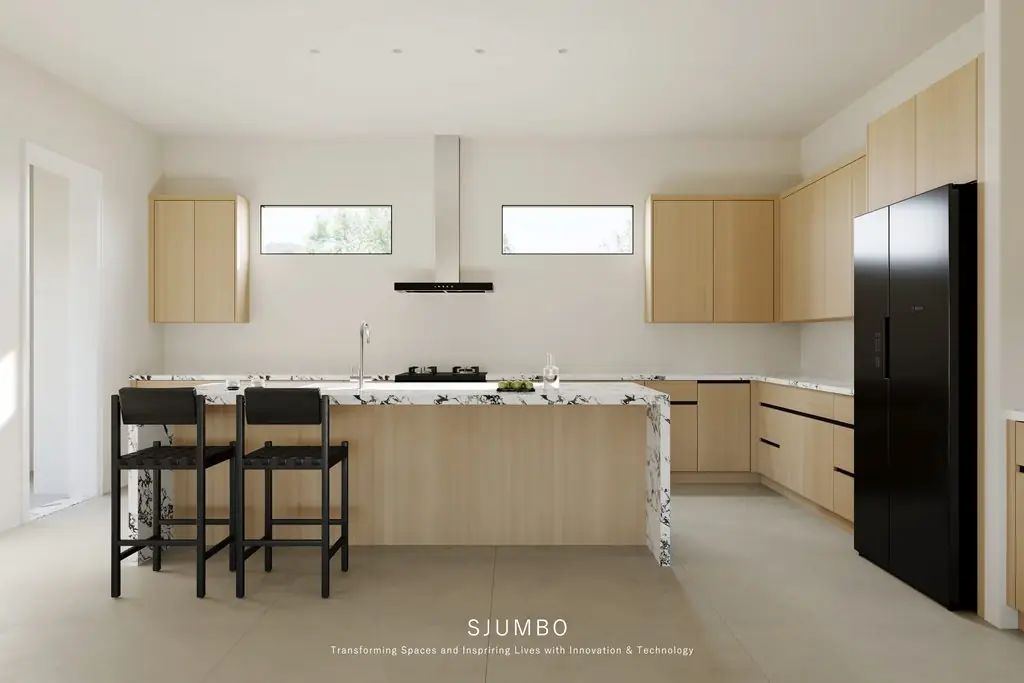
What material is premium for kitchen cabinets? How do you compare moisture-proof bathroom cabinet options? The core rule is shared substrate, tailored surfaces — using the same base material across spaces eliminates visual disconnect, while different face materials match each room’s unique needs.
You don’t need identical materials and colors in every room to achieve full-house color integration. A smarter approach is a same hue, different saturation, different texture gradient from public to private spaces. For example, use light gray matte PET doors in the kitchen, and deeper gray wood-grain moisture-resistant panels in the bathroom. The color family stays consistent, but shifts from lighter to darker and from smooth to textured as you move from public to private zones. This maintains visual flow while defining each space’s function — perfect for open layouts, and completely avoids a patchwork feel.
Detail consistency is what separates premium custom cabinetry from average work. SJUMBO uses PUR and laser edge banding across all projects: color-matched edge tape is thermally fused to the panel with virtually invisible glue lines, improving moisture sealing while eliminating the cheap look of mismatched edge color. For hardware, you can either go with handleless push-to-open systems for a seamless look, or use the exact same handle style and finish throughout the entire home — kitchen cabinets, bathroom vanities, and all storage pieces. Small as these details are, they make a huge difference in how polished and intentional the final result feels.
We do not recommend uniform panels across both spaces. Kitchens prioritize grease resistance and load-bearing capacity, while bathrooms demand stronger moisture and vapor resistance. Using one material for both means compromising either cleanability in the kitchen or long-term durability in the bathroom. A smarter approach is same color, different material or same substrate, different face — for example, use moisture-resistant multi-ply for the cabinet boxes in both rooms, but pair it with PET doors in the kitchen and moisture-resistant wood veneer in the bathroom. This keeps visuals consistent while matching each space’s functional needs.
Focus your budget on what people actually see. Use cost-effective moisture-resistant boards for the cabinet boxes — they deliver structural performance and moisture protection without a premium price tag. Then allocate more of your budget to door finishes (such as premium matte PET or natural wood veneer) and high-quality hardware. Since doors and hardware are what people notice most, upgrading those delivers the biggest visual impact. Pair that with unified edge banding and hardware across the home, and you can achieve a cohesive, high-end look without overspending on hidden materials.
For full-house custom projects, the key to great kitchen and bathroom material matching is finding the right balance between function, aesthetics, and cost. As a full-house custom manufacturer with 16 years of export experience, SJUMBO applies consistent standards from material selection and edge banding to color coordination, helping you avoid patchy, cheap-looking results and deliver unified, high-quality spaces. If you have project requirements or material selection questions, feel free to reach out to our team.
Every architectural and contracting team has encountere […]
When a boutique hotel or commercial property project co […]
The Nightmare Scenario: “Just two seasons after h […]
Six months after handover, a project manager’s wo […]
Related links:
About Us Company News Industry Updates Kitchen Cabinets Bathroom Suites Wardrobes Wall Systems Doors Windows & Balustrades SSL 100% Secure Transactions