
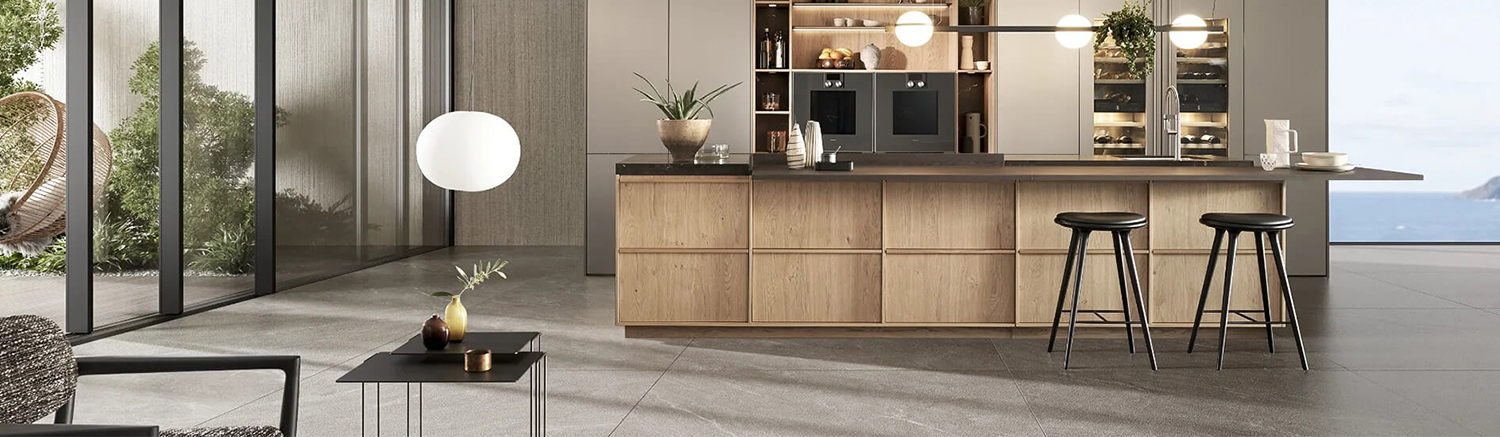
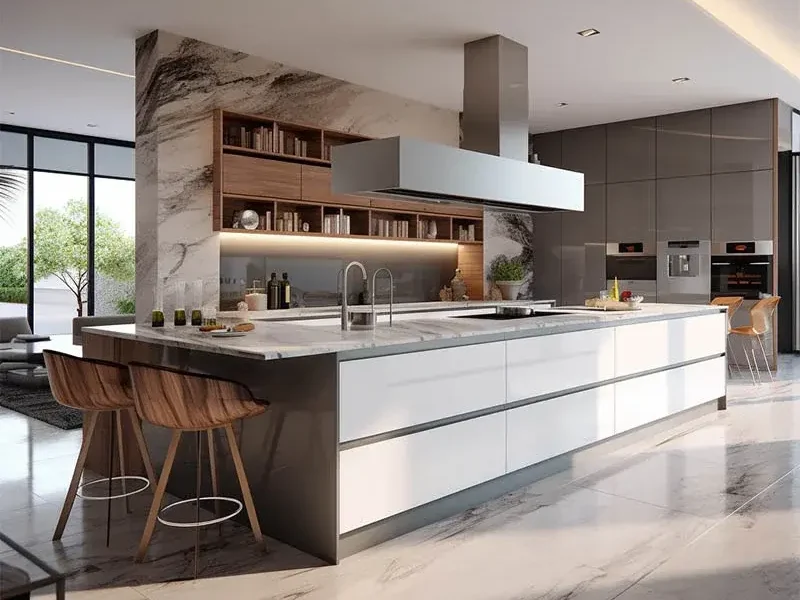
When renovating an apartment kitchen, choosing the right kitchen cabinet finish often comes with endless dilemmas: oil stains from daily cooking need easy cleaning, frequent use by tenants must withstand wear and tear, self-occupied spaces demand aesthetic appeal, and the budget can’t be overrun. As the core of the kitchen, a suitable kitchen cabinet finish directly impacts living experience and project cost-effectiveness. Today, we’ll break down the key differences between melamine kitchen cabinets and lacquer kitchen cabinets from process details, practical scenarios to real cases, paired with common questions, to help you accurately match your apartment project needs.
The finish of melamine kitchen cabinets is made by fusing decorative paper impregnated with eco-friendly resin with E0-grade substrates (particleboard or MDF) under 150℃ high temperature and 25kg/cm² high pressure. Interestingly, the beauty of this process lies in “consistency from surface to core” – the texture and color of the decorative paper fully penetrate, so even minor surface wear won’t reveal the base color.
In SJUMBO’s Vancouver apartment project (Canada) and California single-family home project (USA), we used melamine kitchen cabinets paired with frosted glass doors. Light gray wood grain finishes with metal handles created a sleek modern look, while withstanding 3 years of high-frequency use by tenants. Project feedback shows that soy sauce stains and knife scratches can be easily handled; cleaning only requires neutral detergent and a damp cloth, no extra maintenance needed. Its applicable scenarios are clear: rental apartments, affordable self-occupied apartments, or families with high kitchen usage – after all, no one wants to coddle their kitchen cabinets every day.
Lacquer kitchen cabinets follow a “precision craftsmanship route”: using solid wood or high-quality MDF as the substrate, undergoing 3 rounds of sanding, 8-12 coats of spraying (including primer, color paint, and clear coat), followed by curing via UV technology, with a paint thickness of up to 0.3mm. To be honest, this process is the ultimate test of factory strength – even slight uneven spraying can cause drips or bubbles.
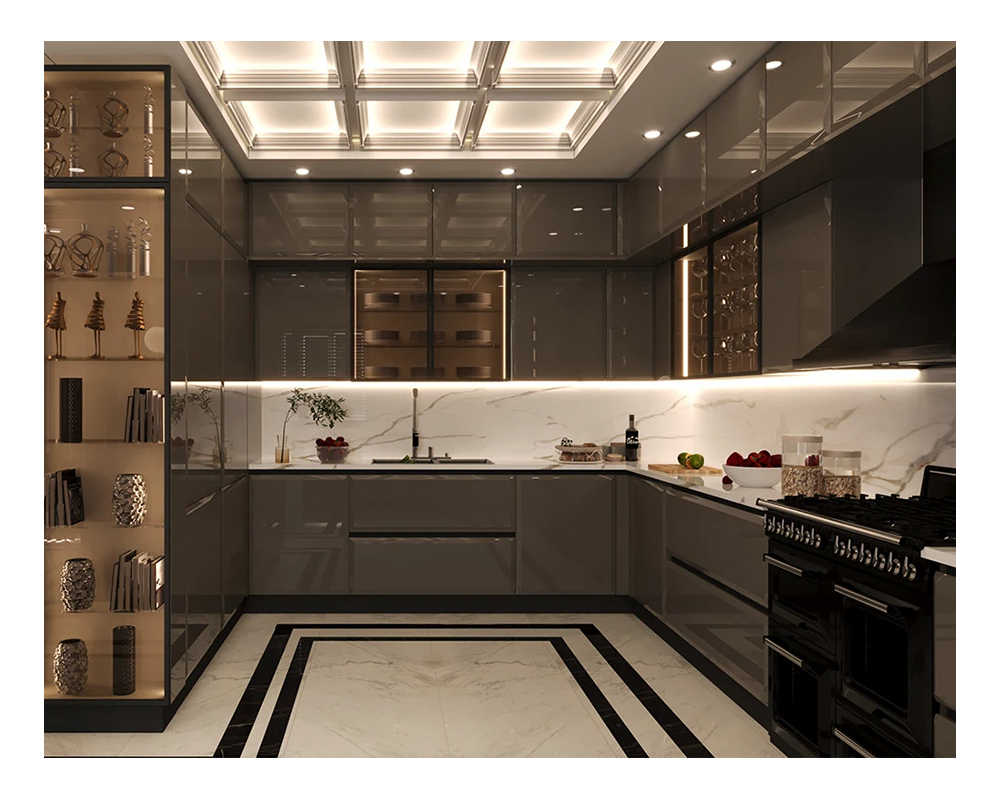
SJUMBO’s dedicated “Lacquer Solid Wood Production Line” adopts automated spraying equipment and constant-temperature curing rooms, controlling the paint uniformity error within 0.02mm, and passing the yellowing resistance test (no obvious discoloration after 500 hours of UV irradiation). In a high-end apartment project in Pudong, Shanghai, we used matte white lacquer kitchen cabinets paired with quartz countertops. The seamless finish and delicate texture instantly elevated the kitchen to luxury standards. It’s more suitable for homeowners pursuing quality of life or high-end apartment projects – after all, aesthetics and texture are always bonus points for high-end renovations.
| Comparison Dimension | Melamine Kitchen Cabinets | Lacquer Kitchen Cabinets |
| Durability | Scratch-resistant (Mohs hardness ≥4), stain-proof, no chipping risk | Yellowing-resistant, easy to repair (minor scratches can be polished), prone to chipping from heavy impacts |
| Environmental Grade | E0 environmental standard, odorless (formaldehyde emission ≤0.124mg/m³) | E0-grade substrate + eco-friendly paint, ready for use after 7 days of ventilation post-installation |
| Style Adaptability | Modern minimalist, Nordic, industrial styles; rich wood grain options | Light luxury, minimalist, new Chinese styles; customizable high-gloss/matte finishes |
| Production Cycle | 7-10 working days (spot colors can be expedited to 5 days) | 15-22 working days (additional 3 days for custom colors) |
| Maintenance Difficulty | Low (neutral detergent + damp cloth suffices) | Medium (avoid strong acids/alkalis; regular maintenance with special wax required) |
A: Melamine kitchen cabinets produced by regular manufacturers use E0-grade substrates, and the resin itself is eco-friendly. They can be occupied after 3-5 days of ventilation post-installation. SJUMBO’s products undergo additional formaldehyde removal treatment – feedback from homeowners in the Vancouver apartment project shows almost no odor on installation day.
A: Ordinary lacquer is prone to yellowing, but SJUMBO’s lacquer kitchen cabinets use imported yellowing-resistant paint paired with UV curing technology, maintaining no obvious discoloration for 5-8 years of normal use. A homeowner in Shenzhen we served has had lacquer kitchen cabinets for 6 years, and they still retain their original milky white color.
A: Absolutely! Many apartment projects use melamine kitchen cabinets for lower cabinets (durable and easy to clean) and lacquer kitchen cabinets for upper cabinets (aesthetic enhancement), paired with matching countertops for a cohesive look. SJUMBO’s one-stop service ensures precise color matching, eliminating the risk of mismatched styles.
A: SJUMBO boasts a 20,000-square-meter production facility, with a daily capacity of 300 sets for melamine kitchen cabinets and 150 sets for lacquer kitchen cabinets. Even for bulk orders of thousands of sets, we guarantee delivery within 45 days. Previously, for an apartment project in Hangzhou, we delivered 800 sets of melamine kitchen cabinets in just 38 days.
Whether you choose melamine kitchen cabinets or lacquer kitchen cabinets, we offer “one-stop door-wall-cabinet integration” customization – from kitchen cabinets to entrance cabinets and balcony cabinets, unified materials and colors ensure cohesive apartment decoration. With a 20,000-square-meter production base and 10 years of experience in apartment projects, we guarantee delivery efficiency for bulk orders while controlling costs through refined craftsmanship, allowing you to obtain high-quality products within budget.
Still undecided? Contact us today to receive free samples of both finishes and the “Apartment Kitchen Cabinet Selection Guide”. Our design team will provide personalized recommendations based on your project’s layout, budget, and style. After all, the best kitchen cabinet is always the one that fits your needs, not just a trend~
In 2026, in the design of high-end residential spaces, […]
Bathroom vanity warping and sound insulation collapsing […]
Less than six months after handoff on a luxury villa pr […]
When a boutique hotel or commercial property project co […]
Related links:
About Us Company News Industry Updates Kitchen Cabinets Bathroom Suites Wardrobes Wall Systems Doors Windows & Balustrades SSL 100% Secure Transactions