
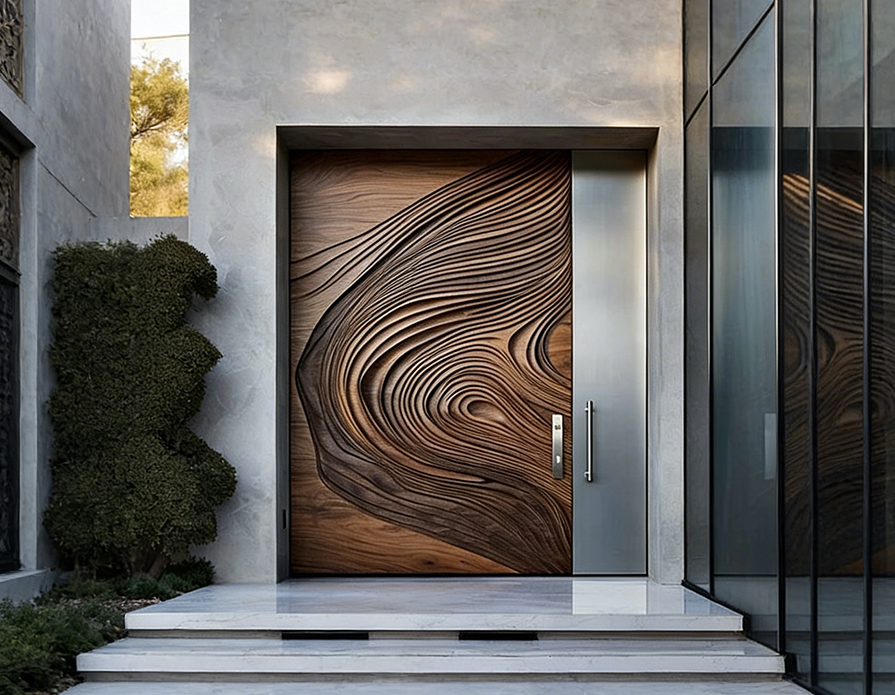
In supporting projects for high-end villas, pivot doors are widely adopted for their unique rotating structure and outstanding visual presentation. After long-term operation on multiple sites, heavy-duty luxury villa entry pivot doors gradually develop sagging issues. The displaced door leaves scratch floor finishes repeatedly, triggering a series of engineering rework problems, which must be fully controlled during design and material selection.
Door sagging is never a minor cosmetic defect in engineering projects. The continuous displacement of door leaves will leave permanent scratches and abrasion on premium floor materials such as marble, stone slabs and solid wood, increasing long-term maintenance costs. An unbalanced door leaf also leads to uneven gaps around the door frame, ruining the integrated aesthetic of the entrance facade. Jamming and abnormal metal noise during opening and closing greatly degrade user experience and eventually result in mass customer complaints. In fact, tiny initial deformations will evolve into major rework requiring full disassembly if left unaddressed.
Wooden grids commonly used for internal support have inherent performance limitations. Wood expands and contracts constantly with changes in ambient temperature and humidity. Under sustained load from heavy door leaves, material creep occurs gradually. Accumulated deformation will pull oversized entry doors downward over time, which is the primary internal cause of door sagging. The stiffness of pure wooden structures can never meet the long-term load requirements of extra-large and heavy door assemblies.
Outdoor-installed pivot doors operate under far more complex load conditions than interior doors. Apart from self-weight, they bear continuous lateral tension and impact from all-weather wind load. Many projects mistakenly apply light-duty indoor pivot hardware, which is not reinforced for outdoor working conditions. The shafts and bearings operate under persistent overload and wear out rapidly. Once the load-bearing points become loose, door tilt and floor scratching will occur quickly.
Floor pivots act as the core load-bearing fulcrum for the entire door, and their stability fully relies on the ground base structure. Floors equipped with underfloor heating insulation or lightweight backfill feature much lower overall rigidity compared with solid reinforced concrete floors. If heavy-duty floor pivots are anchored directly on soft base layers, combined with natural building settlement, pivot displacement is inevitable. Does ground base material really determine the service life of a full door set? Practical engineering cases have proven this conclusion clearly.
Calculating only the net weight of door leaves cannot meet engineering-level material selection standards. For outdoor applications, various external forces must be taken into comprehensive consideration. A 1.5 times door weight safety factor is generally adopted in the industry to reserve sufficient margin for dynamic load, sudden strong wind and building settlement. Based on abundant project experience, we have sorted out a complete load calculation checklist and standardized selection table.
| Door Size (H × W) | Estimated Total Weight | Recommended Deformation-resistant Core | Matched Hydraulic Floor Pivots & Heavy-duty Pivot Hinges | Allowable Deflection Limit | Ground Base Requirement |
|---|---|---|---|---|---|
| 2.4m × 1.2m | 80kg – 120kg | Solid wood composite + Double reinforced panels | Light-duty pivot hardware | ≤1.5mm | Ordinary concrete floor with standard anchoring |
| 3.0m × 1.5m | 150kg – 200kg | Vertical aluminum keel + Built-in corrector | 250kg-class heavy-duty hydraulic pivot set | ≤2.0mm | Thickened concrete layer, partial lightweight backfill is prohibited |
| Over 3.5m × Over 1.8m | Over 300kg | Carbon fiber composite matrix + Anti-corrosion steel lining + Aviation aluminum pipe network | 500kg-class ultra-heavy-duty pivot system (Support adjustment without removing door leaf) | ≤2.5mm | Direct anchoring on reinforced concrete layer; installation on heating layer or soft backfill is strictly forbidden |
Deflection limit mentioned in the table refers to the natural sagging value of door leaves under self-weight. A smaller figure represents higher overall rigidity and stability, which is a key technical index for engineering acceptance.
To fundamentally prevent door deformation, sagging and floor scratching, standardized factory workflows must be strictly implemented. Comprehensive reinforcement shall be conducted from three aspects: internal framework, supporting hardware and adjustment system, forming a complete protection solution.
Replace traditional deformable wooden grids. Install anti-corrosion bidirectional steel liners or aviation aluminum pipe network keels inside door leaves. High-rigidity industrial materials eliminate wood creep and humidity deformation, and improve the overall anti-deformation performance fundamentally.
Select supporting hardware strictly in accordance with calculated load values. Adopt hydraulic floor pivots and heavy-duty pivot hinges equipped with hydraulic dampening function. All hardware sets reserve a 1.5 times door weight safety factor to withstand sustained outdoor wind load and dynamic impact.
Top and bottom pivots are equipped with built-in adjusting screws. Operators can achieve ±3mm vertical and horizontal fine adjustment without detaching door leaves, to correct position deviation caused by building settlement and minor hardware wear.
Q: How long will observable sagging deformation occur on heavy-duty luxury villa entry pivot doors under normal outdoor working conditions?
A: Doors with qualified core structure, hardware and installation will remain stable for long-term service. If hardware with insufficient load rating is selected, visible sagging and floor scratching will appear within six months to one year in most projects.
Q: Can slight sagging and floor scratching be fully repaired via on-site commissioning?
A: Deviation caused only by pivot position can be corrected with the 3D adjustment function of hydraulic floor pivots. However, if permanent creep deformation has occurred inside the door core, the repair effect will be limited, and it is difficult to restore to the original factory standard.
Q: What extra design requirements are needed when customizing oversized entry doors for windy coastal and mountainous areas?
A: Wind load is much higher in these areas. Besides raising the door weight safety factor, lateral limit accessories can be installed to reduce lateral pull on pivots and extend the service life of the entire door and hardware assembly.
Q: When making engineering selection, should door size or load parameters be prioritized?
A: The two factors need to be evaluated jointly. Door opening size determines the basic weight of the door leaf, while load parameters guide the selection of internal structure and hardware grade. Matching complete accessories based on actual measured weight is the reliable logic for engineering selection.
With rich experience in full-home customized engineering, SJUMBO adheres to integrated delivery mode and abandons the traditional on-site random assembly method. For high-end villa door projects, we provide one-stop factory pre-embedding and pre-commissioning service for door frames, door leaves and heavy-duty floor pivots. All bearing mounting holes are precisely cut by CNC machine tools, with machining error controlled within ±0.1mm.
Every pivot door leaving our factory undergoes 10,000 opening-closing fatigue tests to simulate wear and deformation risks during long-term operation, and eliminate potential engineering hazards in advance. After delivery to construction sites, field teams only need to complete simple hoisting and positioning work to meet the designed deflection standard, which greatly improves overall construction efficiency.
We implement full-process standardized quality control covering structural reinforcement, hardware selection, factory inspection and on-site delivery. Every pivot door from SJUMBO can steadily adapt to the long-term service conditions of high-end villas.
When managing a real estate or renovation project, have […]
Choosing custom cabinetry for multi-family residential […]
A bathroom vanity is the centerpiece of both functional […]
Melbourne wardrobe door warping is one of the most pers […]
Related links:
About Us Company News Industry Updates Kitchen Cabinets Bathroom Suites Wardrobes Wall Systems Doors Windows & Balustrades SSL 100% Secure Transactions