
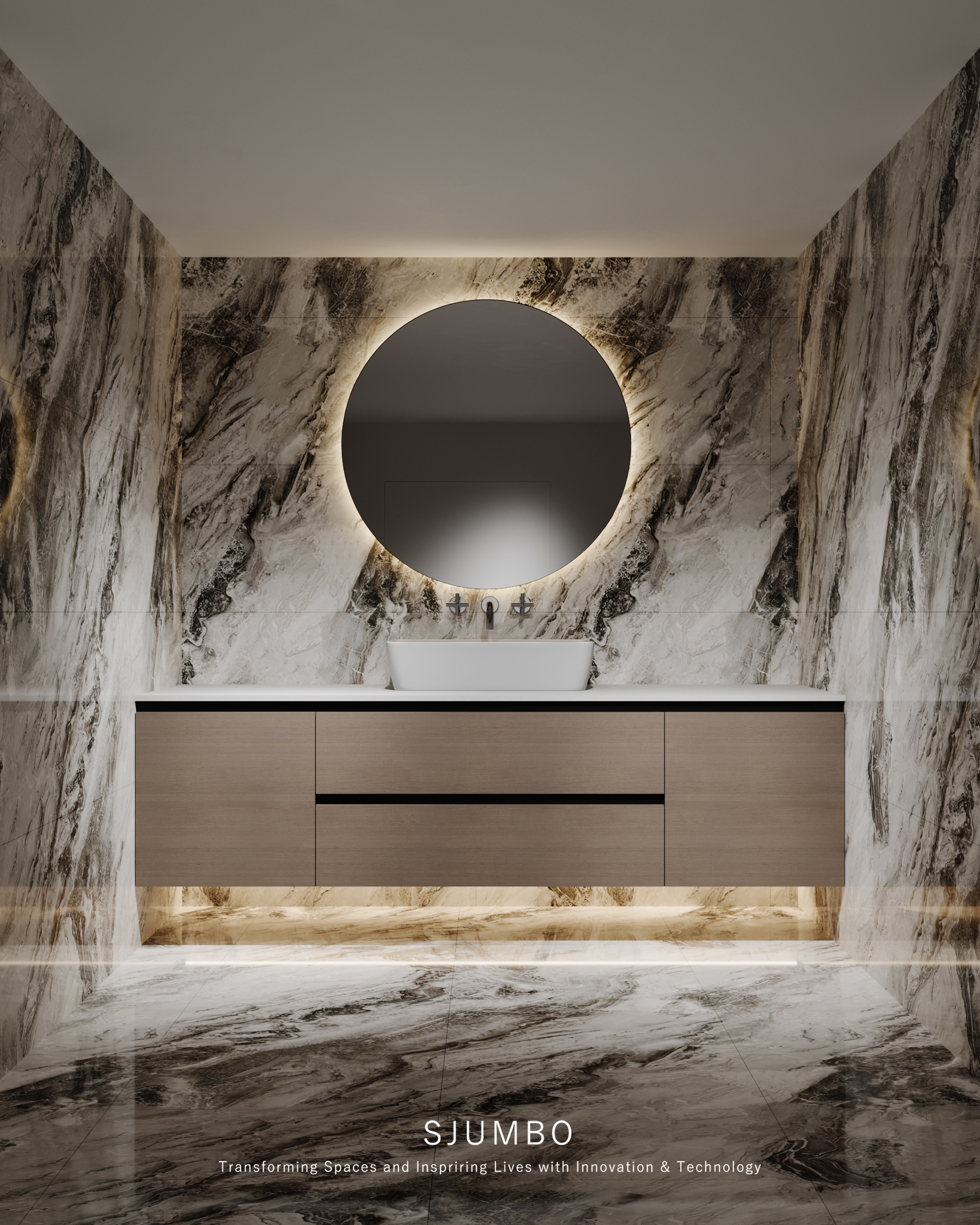
Most families who have renovated their bathrooms have encountered such troubles: the countertop of the bathroom vanity develops fine cracks soon after use, and the area around the basin is even a high-incidence area for cracking, which not only affects the appearance but also easily causes water seepage and mildew. With 16 years of experience in whole-house customization, SJUMBO has handled the customization and installation of thousands of sintered stone bathroom vanity tops, and knows that anti-cracking of bathroom vanity countertops is the core demand of users. The thickness of the sintered stone directly determines the durability of the countertop. Many people blindly choose thin slabs or blindly pursue thick slabs, and end up making wrong choices. Today, we use the latest laboratory test data in 2026 to talk about the real performance of sintered stone of different thicknesses on bathroom vanity countertops, and help you avoid cracking traps.
The sintered stone used for bathroom vanities on the market is mainly divided into three specifications: 6mm, 12mm, and 20mm. The positioning and durability of different thicknesses are vastly different, and the more expensive and thicker one is not necessarily suitable.
We have compiled the core performance data measured by SJUMBO Laboratory in 2026 to intuitively compare the differences between the three thicknesses:
| Sintered Stone Thickness | Mohs Hardness | Modulus of Rupture (MPa) | Water Absorption (%) | Adapted Bathroom Vanity Type | Basic Anti-Cracking Grade |
|---|---|---|---|---|---|
| 6mm | 6-7 | 45-50 | ≤0.02 | Small Wall-Mounted Minimalist | General |
| 12mm | 6-7 | 55-60 | ≤0.01 | Mainstream Household Floor-Standing | Good |
| 20mm | 7 | 65-70 | ≤0.01 | Large-Size High-End Customized | Excellent |
Many people think that thick sintered stone will not crack, but actual tests find that selection of sintered stone thickness is only the foundation, and technology and use environment are the core of anti-cracking.
Hair dryers, glass skin care product bottles, and metal wash cups are often accidentally dropped in the bathroom, which is the most common damage scenario for bathroom vanity countertops. We conducted impact tests with 1.5kg standard heavy objects:
6mm sintered stone has through cracks after impact, and the edges are extremely easy to chip;
12mm sintered stone only has shallow marks on the surface without structural cracking;
20mm sintered stone has almost no damage, and its impact resistance is far better than the former two.
Bathrooms have alternating hot and cold temperatures all year round. Hot water washing and cold water flushing will make the sintered stone expand and contract repeatedly, and thin sintered stone is easy to deform and crack. After 1000 cycles of temperature difference tests, the edges of 6mm sintered stone are slightly warped, and the deformation of 12mm and 20mm sintered stone is controlled within 0.1mm, with stability fully meeting household needs.
Basin drilling is the stress concentration point of bathroom vanity countertops and a high-incidence area for cracking. Summarized from 16 years of customization experience, if the drilling R-angle treatment is not in place, even the thickest sintered stone will crack. SJUMBO uniformly adopts R5 large fillet technology, which can reduce 60% of drilling cracking risk compared with ordinary R3 angle, among which 20mm sintered stone has the best drilling stability.
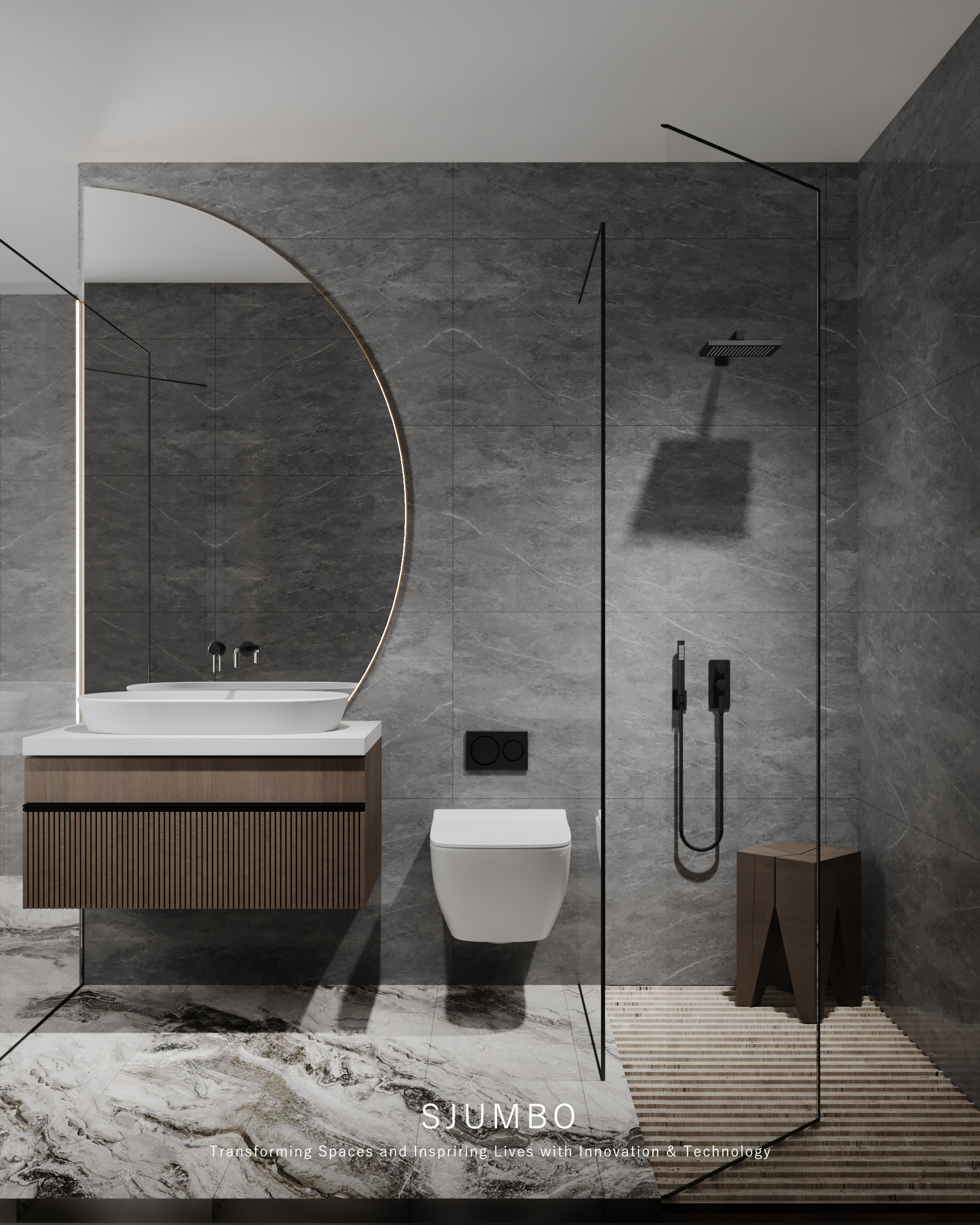
The bottom support of the sintered stone countertop is often more important than the thickness. We have compared two common support methods:
This is why SJUMBO insists on standard aluminum alloy support frames when customizing bathroom vanities, eliminating cracking risks from the bottom layer.
Choose 20mm for sufficient budget, 12mm for cost performance, and 6mm is not recommended for separate countertops, except for reinforced composite models.
Avoid heavy objects smashing the edge of the basin violently, do not place high-temperature utensils for a long time, and regularly check whether the support frame is loose, which can greatly extend the service life.
Relying on 16 years of whole-house customization experience, we control the whole process from sintered stone material selection, bathroom vanity sintered stone drilling technology to support structure. All sintered stone bathroom vanity tops have passed anti-cracking tests, providing users with long-term use guarantees.
When choosing a bathroom vanity countertop, you can’t just look at the appearance, anti-cracking performance is the core of measuring quality. Combining selection of sintered stone thickness, process details and support structure, you can choose a durable sintered stone bathroom vanity top without pitfalls. If you need to customize a bathroom vanity suitable for your house type, you can visit the official website of SJUMBO , 16 years of customization experience to create a durable and beautiful bathroom space for you.
Why Mass Cabinetry Projects Fail? Commercial multi-fami […]
In 2026, whole house customization has become the bench […]
Bathroom vanity warping and sound insulation collapsing […]
luxury property renovation for multi-family buildings a […]
Related links:
About Us Company News Industry Updates Kitchen Cabinets Bathroom Suites Wardrobes Wall Systems Doors Windows & Balustrades SSL 100% Secure Transactions