In the overall planning of Multi-family Housing Projects, cabinetry (especially multi-family housing cabinetry customization) is not only the functional core of the kitchen but also a key link affecting the project’s Total Cost of Ownership (TCO), long-term operation and maintenance efficiency, and residential experience. Many project managers tend to go to extremes when controlling budgets—either blindly cutting costs leading to frequent failures later, or over-investing resulting in resource waste. With 16 years of experience in full-home customization, SJUMBO believes that the core of cabinetry design for multi-family scenarios is to do a good job in Value Engineering (VE), striking a precise balance between cost and quality without reducing usage standards, while taking into account Durability & Maintenance.
Value Engineering (VE) is never a simple material downgrade, but through scientific material comparison, structural optimization, and process selection, to make cabinetry adapt to high-frequency and large-scale usage scenarios. The usage density of kitchen spaces in multi-family residences is much higher than that in ordinary residences, with frequent opening and closing, high humidity, and heavy oil fumes. These characteristics determine that the configuration of cabinetry cannot copy the home-based thinking. Reasonable optimization where it can be streamlined and uncompromising investment where it is necessary can make the project both cost-effective and long-term competitive, and truly reduce the Total Cost of Ownership (TCO).
Combined with the characteristics of large-scale implementation of Multi-family Housing Projects, the following modules can be optimized to control costs without affecting the basic functions and overall appearance of cabinetry, while taking into account environmental protection and practical needs. Especially in the selection of cabinet base materials, we have made a detailed parameter comparison to make the choice more evidence-based:
Choose eco-friendly Melamine Faced Chipboard (MFC) instead of Plywood. The Formaldehyde Emission of the former can reach ENF grade (≤0.025mg/m³) or E1 grade (≤0.124mg/m³), which fully meets international environmental standards. Its Moisture Resistance is excellent, with a water absorption rate ≤8%, which is not easy to deform or swell in the humid kitchen environment, and is more suitable for large-scale production needs; although Plywood has a slightly better texture, its formaldehyde emission is difficult to stably control at ENF grade, and the mass production cost is 15%-20% higher, which is not cost-effective for multi-family projects, especially not suitable for bulk cabinetry customization scenarios.
In addition to the base material, these links can also be reasonably optimized:
| Component | VE Solution | Cost Impact | Long-term Benefit |
|---|---|---|---|
| Carcass Material | MFC (Melamine Faced Chipboard) instead of Plywood | Reduced by 15%-20% | Stable physical performance, formaldehyde emission reaches ENF/E1 level, moisture-proof and anti-deformation, easy for mass production, and lower initial procurement costs |
| Edge Banding Process | Laser Edging instead of Traditional Edging | Slightly increased initial cost (about 5%-8%) | Extremely high: Strong sealing, preventing moisture and oil fumes from penetrating, avoiding board swelling due to moisture, reducing after-sales rate by 50%, and extending cabinet service life |
| Hardware System | International Brands (Blum/Hettich) instead of Ordinary Hardware | Increased by 10% | Extremely high: Passed 100,000 times Cycle Test, 10+ years maintenance-free, reducing later maintenance rate by 60%, and improving project brand premium |
| Handle Design | J-Pull (Hidden Handle) instead of Exposed Handle | Reduced by 5% | Saves hardware procurement and installation labor costs, convenient cleaning without dead corners, and improves the overall simple texture of the kitchen |
Seemingly cost-saving streamlining, if used in key parts, will instead greatly increase long-term operation and maintenance costs and raise the Total Cost of Ownership (TCO). In many Multi-family Housing Projects served by SJUMBO, we always insist on full investment in core links, which is the key to the Durability & Maintenance of cabinetry and the core to enhance project competitiveness.
Brand cabinetry hardware is the heart of the entire cabinet, directly determining the service life and user experience of cabinetry, and also a core highlight of high-quality cabinetry customization. We choose guide rails and hinges from internationally renowned brands such as Blum and Hettich. All these hardware have passed 100,000 times Cycle Test, with smooth opening and closing without jamming or noise. In the high-frequency use scenarios of multi-family residences, they are not easy to loose or deform. Compared with ordinary hardware, they can reduce the later maintenance rate by 60%, truly achieving 10+ years maintenance-free, fundamentally reducing after-sales costs and lowering the Total Cost of Ownership (TCO).
Compared with traditional edging, the cabinetry laser edging process has obvious advantages, and it is also a common process for high-end cabinetry customization. Traditional edging has the problems of obvious glue lines and poor sealing. After long-term use, edge banding is easy to fall off and boards are easy to swell due to moisture, increasing the later maintenance workload; while laser edging adopts high-temperature melting technology to achieve seamless bonding between boards and edge banding, with no glue lines and extremely strong sealing. It can effectively block kitchen moisture and oil fumes from penetrating into the boards, avoiding board swelling and deformation, and the after-sales rate can be reduced by 50%. Although the initial cost is slightly increased, it can greatly reduce operation and maintenance investment in the long run and improve the Durability & Maintenance of cabinetry.
As a high-frequency contact area in the kitchen, the countertop’s durability directly affects the overall user experience and service life of cabinetry. We recommend choosing quartz stone or slate materials. These materials have strong stain resistance (stains are not easy to penetrate), scratch resistance and wear resistance (Mohs hardness can reach 6-7 levels), and are easy to clean. They do not need frequent renovation and maintenance, which is suitable for the long-term use needs of Multi-family Housing Projects. At the same time, they can reduce later maintenance costs and lower the Total Cost of Ownership (TCO).
To achieve a refined visual effect of cabinetry, there is no need to rely on high-cost materials and processes. Through reasonable design matching and combined with Modular Kitchen Design, a high-end texture can be achieved at a lower cost, and at the same time, it can adapt to the unified aesthetic needs of multi-family projects.
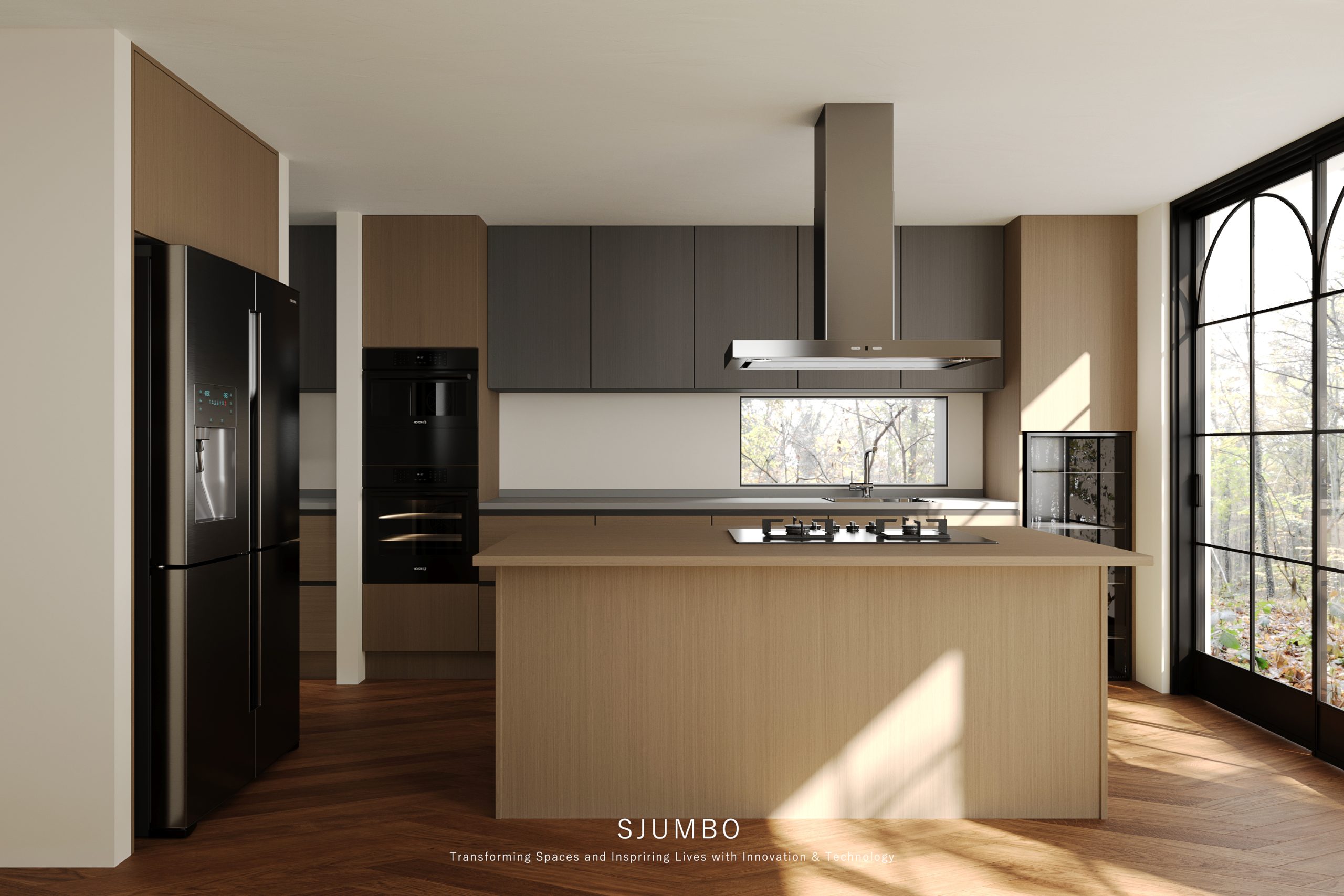
Choose high-gloss double-sided decorative panels to restore the delicate luster of painted doors. The price is about 30% lower than that of painted doors, and it is more wear-resistant and easy to clean, suitable for mass production; adopt handleless cabinetry with J-type handleless design to save the cost of exposed handles, and make the kitchen lines more concise, with no dead corners during cleaning. Matching light-colored cabinets with simple countertops can not only enlarge the visual effect of the space but also adapt to different decoration styles, meeting the unified delivery standards of multi-family projects and the aesthetic needs of bulk cabinetry customization.
Empty talk is not as good as data. According to the actual measured data of SJUMBO in a 200-unit apartment project in Melbourne: by implementing the above Value Engineering (VE) solutions, including Modular Kitchen Design, MFC base material, laser edging, and international brand hardware, the Kitchen Cabinetry Budget was saved by about $120,000. At the same time, due to the adoption of laser edging and brand hardware, the number of maintenance orders in the first year of occupancy was close to zero, which greatly reduced the later operation and maintenance costs, truly achieving a win-win situation between Cost Impact and Long-term Benefit. It also confirms the core value of Value Engineering (VE) in cabinetry customization for Multi-family Housing Projects—it is not a downgrade, but an optimal solution for cost performance and quality, reducing the Total Cost of Ownership (TCO).
With 16 years of experience in full-home customization, SJUMBO has deep roots in the cabinetry customization field, familiar with the core needs of Multi-family Housing Projects, and is good at planning multi-family housing cabinetry customization solutions. It can integrate the concept of Value Engineering (VE) throughout the whole process, and combine Modular Kitchen Design to provide project parties with one-stop full-process services from design, production to installation and after-sales, taking into account Durability & Maintenance, so that every budget is used in key places.
Q1: How does Value Engineering affect the delivery standard of multi-family cabinets?
A1: Value Engineering (VE) will not reduce the delivery standard of multi-family cabinets at all. The optimization only targets non-core configurations such as cabinet base materials and internal fittings. The environmental protection standards (formaldehyde emission reaches ENF/E1 level), Durability & Maintenance, and appearance texture of the cabinetry will all maintain the unified high standard required by the project. At the same time, through scientific configuration, it can also improve the overall quality of the cabinetry and enhance the competitiveness of the project delivery.
Q2: Can Modular Kitchen Design fit kitchens of different layouts in multi-family projects?
A2: Yes. The Modular Kitchen Design adopts a flexible combination mode. On the basis of standard modules, it can be slightly adjusted according to the size and layout of different kitchen spaces. It not only enjoys the advantages of mass production (reducing costs and improving delivery efficiency) but also can perfectly fit the kitchen spaces of various sizes in multi-family projects, avoiding the waste caused by custom sizes, which is very suitable for bulk cabinetry customization.
Q3: Is there exclusive support for the later operation and maintenance of cabinetry in multi-family projects?
A3: SJUMBO provides full-process follow-up services for multi-family projects. From bulk cabinetry customization to installation and after-sales warranty, there are special personnel to dock. The cabinetry provides a 3-year warranty, and the brand hardware adopts international big brands with 10-year+ maintenance-free service, which can effectively solve the operation and maintenance concerns of the project party and reduce the Total Cost of Ownership (TCO).
Q4: What is the ROI of using laser edging in rental apartments?
A4: The initial cost of laser edging is slightly increased (about 5%-8%), but its long-term ROI is very high. According to the actual data of SJUMBO’s projects, the use of laser edging can reduce the after-sales maintenance rate of cabinetry by 50%, and avoid the cost of cabinet deformation and maintenance caused by moisture. For multi-family projects with a service life of more than 10 years, the investment in laser edging can be fully recovered within 2-3 years, and the later maintenance cost can be continuously saved, which is a cost-effective investment choice for high-quality cabinetry customization.
Q5: How to balance the Cost Impact and Durability & Maintenance of cabinetry in multi-family projects?
A5: The key lies in grasping the core logic of Value Engineering (VE). For non-core configurations (such as base materials and internal fittings), we can choose cost-effective solutions to control costs; for core links (such as hardware and edge banding), we must invest in high-quality products to ensure Durability & Maintenance. SJUMBO can provide professional customized solutions according to the project budget and needs, helping project parties achieve the balance between cost and quality and maximize the project value for multi-family cabinetry customization.
The core of cabinetry configuration in Multi-family Housing Projects is to understand the underlying logic of Value Engineering (VE), avoid blind cost-saving and invalid investment, balance Cost Impact and Long-term Benefit, and truly reduce the Total Cost of Ownership (TCO). With 16 years of customization experience, SJUMBO can provide professional cabinetrycustomization planning solutions for various multi-family projects, combined with Modular Kitchen Design, to create kitchen spaces that are both durable, practical and aesthetic, helping projects enhance their competitiveness.
Bathroom Vanities is the core configuration of commerci […]
Most families who have renovated their bathrooms have e […]
The most frustrating handover issue happens when expens […]
White lacquer cabinets are the top choice for most home […]
Related links:
About Us Company News Industry Updates Kitchen Cabinets Bathroom Suites Wardrobes Wall Systems Doors Windows & Balustrades SSL 100% Secure Transactions