
Custom dressing room wardrobes come down to two decisions most buyers get wrong: which board goes behind the finish, and which finish survives the room it is going into. Get those right and the cabinet lasts 15 years. Get them wrong and doors warp in the first wet season.
This page is written for builders, developers and homeowners specifying a walk-in or built-in wardrobe. It sets out what each board and finish actually does, where each one fails, and how the wardrobe is made and shipped — so you can specify with confidence instead of guessing from a sample chip.
Particleboard, MDF or plywood — which board belongs in your wardrobe?
All three are supplied at E0 or E1 formaldehyde grade (E0 ≤ 0.5 mg/L, E1 ≤ 1.5 mg/L per GB 18580). The difference between them is not strength — it is how each one handles moisture, screws and span.
Particleboard (E0, 18 mm)
The standard choice for volume residential work. Dimensional stability is good, cost is the lowest of the three, and it takes melamine and PET laminates cleanly.
Its weakness is water. Once an edge is unsealed, particleboard absorbs moisture and swells permanently — it does not recover when it dries. In wet areas we substitute a moisture-grade green core board.
MDF (E0, 18 mm)
MDF has the smoothest, most uniform surface of the three, which is why high-gloss acrylic and sprayed lacquer bond to it better than to anything else. If the door finish is the priority, MDF is usually the substrate.
Two limits to design around: it is the heaviest board here, and it sags over shelf spans beyond 900 mm unless supported. Screw-holding on the edge is also weak, so fixings belong in the face, not the edge.
Plywood (E0, 18 mm)
Plywood is the most forgiving board in difficult conditions — best moisture resistance, best screw-holding, and the strongest over long spans. It is also the lightest per unit of strength.
It costs more, and the exposed edge grain needs either edge banding or a solid timber lip to look finished. Worth it in coastal homes, humid rooms, and anywhere shelves carry real weight.
How to choose
| Board | Best for | Watch out for |
| Particleboard | Carcass and shelving in dry inland homes | Swells if edges unsealed; use green core in wet areas |
| MDF | Door faces for high-gloss acrylic and sprayed lacquer | Heavy; sags over 900 mm spans; weak edge fixings |
| Plywood | Coastal homes, humid rooms, long spans, load-bearing fixings | Premium price; edge grain needs finishing |
Our rule of thumb: particleboard carcass plus MDF doors covers most projects. Move to plywood when the site is within 5 km of the coast, or when shelf spans exceed 900 mm.
Five finishes, and where each one fails
This is where most wardrobe specifications go wrong. A finish that looks perfect in a showroom can fail within 18 months in the wrong room.
Melamine
Matte or woodgrain, with a texture you can feel. Scratch and abrasion resistant, and the most economical of the five — the workhorse finish for volume residential.
Its failure point is the edge, not the face: if banding is poor, the edge chips, and melamine cannot be repaired, only replaced.
PVC (membrane / foil)
PVC is wrapped over the board under vacuum, so profiled doors such as Shaker have no exposed edges at all. That makes it the most moisture-resistant option for shaped doors.
It is not heat resistant. Keep it at least 150 mm from ovens and recessed downlights, or the film will lift.
PET
Available in super-matte or high gloss, with an anti-fingerprint surface. PET is colour-stable under UV, does not yellow, and is recyclable — the best all-rounder for family homes.
It sits above melamine in price but below acrylic, and it hides everyday marks better than either.
Acrylic (PMMA / acrylic lacquer)
Acrylic gives a mirror gloss and the deepest colour saturation of the five. It is hard, non-yellowing and wipe-clean, which is why it is specified for display homes and feature wardrobes.
It does show fine scratches, so panels keep their protective film until installation is complete.
Wood veneer
Real timber, natural grain, and the only finish here that can be repaired and refinished rather than replaced. It ages well and is the usual choice for architect-designed homes.
It needs periodic oiling, and colour variation between batches is natural — expect it rather than reject it.
Comparison
| Finish | Look | Fails when |
| Melamine | Matte / woodgrain, textured | Edges chip if banding is poor; cannot be repaired |
| PVC | Shaker profiles, seamless wrap | Not heat resistant; keep 150 mm from heat sources |
| PET | Super-matte or gloss, anti-fingerprint | Premium over melamine |
| Acrylic | Mirror gloss, deepest colour | Shows fine scratches; needs film until install |
| Veneer | Real timber grain | Needs periodic oiling; natural batch variation |
Edge banding — the detail that decides lifespan
Most wardrobe failures are not the board or the finish. They are the edge.
EVA glue banding (standard)
EVA is a hot-melt adhesive that softens around 80 °C. In a humid room or a coastal home, EVA edges typically lift within two to three years — and once they lift, water enters the board and the panel is finished.
PUR glue banding (our standard)
PUR cures with moisture rather than by cooling, is heat resistant to 140 °C, and leaves a glue line of roughly 0.2 mm that is almost invisible.
It adds about 【3–5%】 to panel cost and roughly doubles edge life. We use PUR on all carcasses as standard and note it in writing on the drawing, because it is the cheapest upgrade that prevents the most common warranty claim.
Built for Australian conditions
Homes here ask more of a wardrobe than European ones do.
Humidity and salt air
Coastal suburbs regularly sit above 70% RH. For those sites we specify moisture-grade boards and PUR banding, and use 304 stainless or marine-coated hardware instead of standard zinc-plated fittings, which rust in salt air.
Temperature swing
A wardrobe against an uninsulated west wall can cycle 30 °C in a single day. Panels are cut with a 2 mm expansion allowance, and doors hang on adjustable hinges so they can be re-aligned after the first summer rather than replaced.
Floor-to-ceiling spans
2.7 m doors are common here and are the number one warping risk. Above 2.4 m we recommend one of three solutions: a plywood core, an aluminium stiffener, or splitting the opening into two doors with a mid rail.
Sizes and layout options
Dimension ranges
| Range | |
| Width | 1,200 – 6,000 mm (wider runs split into modules) |
| Depth | 550 – 650 mm (600 mm suits most; 650 mm for coat storage) |
| Height | 2,100 – 2,700 mm |
| Hanging rail | 1,700 mm long-hang / 900 mm double-hang |
Walk-in, built-in and reach-in
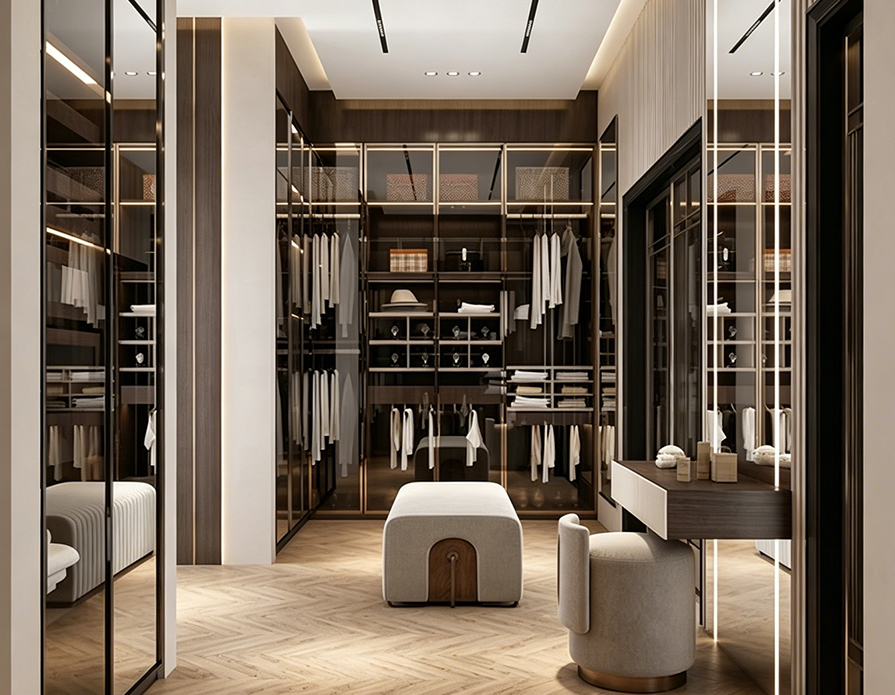
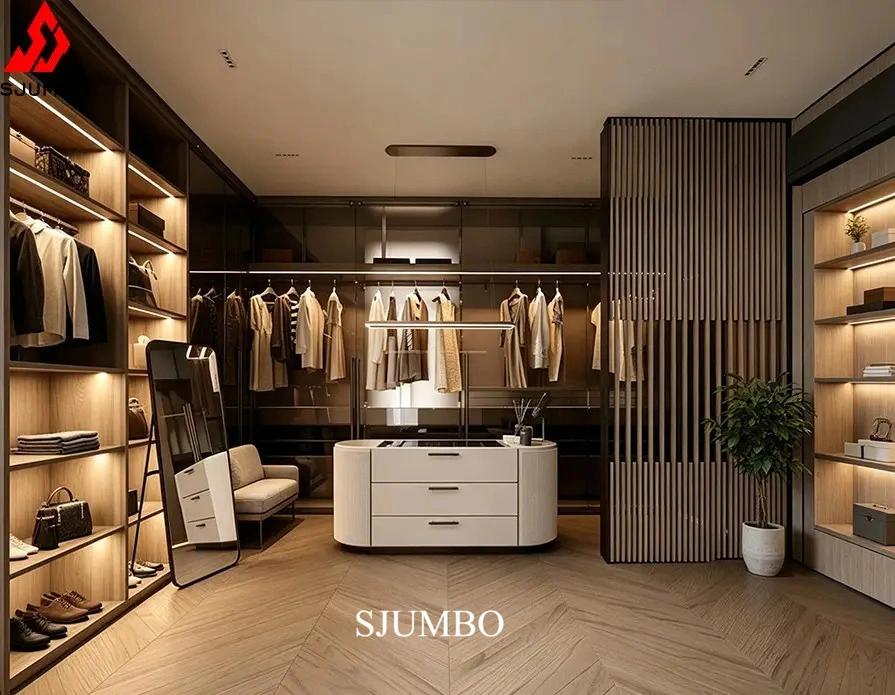
Walk-in combines a perimeter run with a central island, and suits a dedicated dressing room. Built-in is recessed into a wall and uses the full depth of the cavity. Reach-in occupies a single wall with sliding or hinged doors, and suits compact bedrooms.
Every wardrobe is made to measure. Send a floor plan and we return a 3D render and a dimensioned layout drawing within 【48 hours】, free of charge.
Hardware and internal storage
Hinges and slides
Soft-close is standard on every door and drawer. Blum or Hettich is available on request; Blum Clip Top Blumotion hinges are tested to 200,000 cycles.
Internal organisers
Pull-out trouser racks, shoe shelves, felt-lined jewellery drawers, tilt-out hampers, mirror panels, and LED strip lighting that is either motion-sensor or door-activated.
Handles and opening systems
Stainless steel handles as standard. For a handleless look, we offer a Gola profile or push-to-open.
Certifications and compliance
CE · ISO 9001 · CARB Phase 2 · E0 / E1 formaldehyde (GB 18580) · SAI Global
Boards are E0/E1 to GB 18580, and formaldehyde test reports ship with every order. Where a project requires a specific Australian standard, we confirm it against the drawing before production starts.
How your wardrobe is made
1. Drawing and 3D confirmation
We produce 3D renderings and dimensioned layout drawings, and confirm size, layout, board and finish with you before anything is cut.
2. Material selection and testing
E0/E1 boards, the specified finish and hardware are checked against the order, and environmental and durability tests are run on incoming material.
3. CNC cutting
Panels are cut on CNC machinery to within ±0.1 mm, with the 2 mm expansion allowance built into the nest.
4. Edge banding and assembly
PUR edge banding is applied, carcasses are assembled, then door panels, drawers, hardware and any accessories are fitted.
5. Inspection and packing
Hardware cycles, surface finish, seam tightness and function are checked, then the wardrobe is packed in foam board, a five-layer corrugated carton and a wooden crate, with corner protectors.
Lead time, packing and shipping
Lead time
| Stage | Duration |
| Drawing and 3D confirmation | 3–5 working days |
| Production (standard order) | 20–25 working days |
| Production (large project) | 25–30 working days |
| Sea freight to Sydney / Melbourne / Brisbane | 30–45 days |
Packing
Foam board + five-layer corrugated carton + wooden crate, with corner protectors. The crate is built for ocean freight, not for a showroom photo.
Shipping to Australia
We ship FOB or door-to-door DDP/DDU, and issue a tracking number so installation can be scheduled against the build programme rather than guessed at.
Frequently asked questions
Which board should I use in a coastal home?
Plywood with PUR edge banding and marine-coated hardware. Particleboard works inland, but within 5 km of the coast it is the most common cause of swelling claims.
Is acrylic worth the extra cost over PET?
Acrylic gives a deeper, mirror-like gloss and richer colour. PET is nearly as durable, resists fingerprints better and costs less. For family homes we usually recommend PET; for display homes and feature wardrobes, acrylic.
Can you match a finish I have already specified elsewhere in the house?
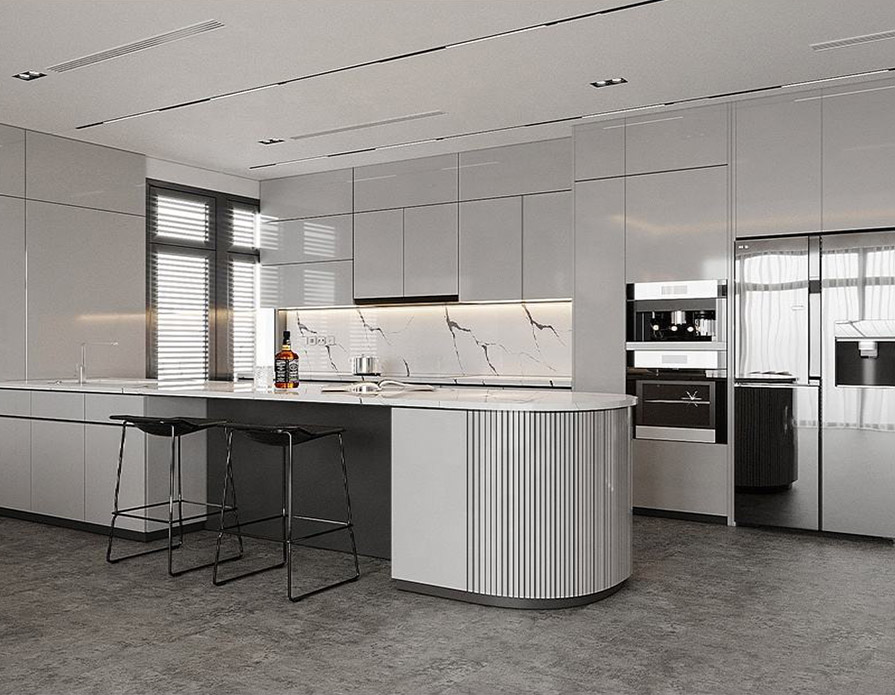
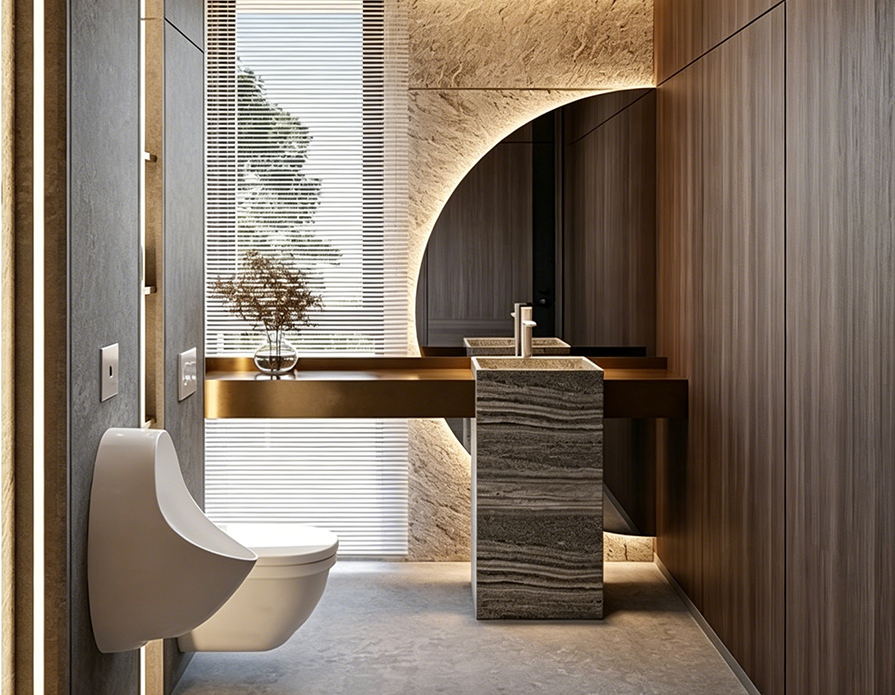
Yes. Send a sample or the manufacturer code and we will match melamine, PET and veneer across wardrobe, kitchen and bathroom, so the whole house reads as one specification.
Do you supply to Australian building standards?
Yes. Boards are E0/E1 to GB 18580 and we hold SAI Global certification. Formaldehyde test reports ship with every order.
What is the production cycle?
20–25 working days for standard custom orders and 25–30 for large projects, plus 30–45 days sea freight.
Can I add storage organisers later?
Yes. Internals use a standard 32 mm drilling system, so shelves, baskets and rails can be moved or added after installation.
Get a quote for your wardrobe
Every wardrobe we make is built to measure, so pricing depends on board, finish, hardware and internal configuration. Tell us what you need and we will come back with a number.
We run a 800 m² showroom in Guangzhou with samples in every finish listed above, backed by a 20,000 m² automated production centre. We have exported to Australia since 2009.
Send your floor plan and we will return a 3D render, a dimensioned drawing and an itemised quote — free of charge.